Showing posts with label pact. Show all posts

Thursday, May 29, 2025

First thoughts on reworking managed attribute test-expectations

When last I wrote about the goblinfish-testing-pact package, I had a checklist of things that I was going to pursue:

Implement all unit tests.
Rework the property/data-descriptor detection to handle properties specifically, and other descriptors more generally:
Member properties can use isinstance(target, property), and can be checked for fget, fset and fdel members not being None.
Other descriptors can use inspect.isdatadescriptor, but are expected to always have the __get__, and at least one of the __set__ and __delete__ members shown in the descriptor protocol docs.
Set test-method expectations based on the presence of get, set and delete methods discovered using this new breakout.
Update tests as needed!
Correct maximum underscores in test-name expectations: no more than two (__init__, not ___init__).
Think about requiring an _unhappy_paths test for methods and functions that have no arguments (or none but self or cls).
Give some thought to whether to require the full set of test-methods for abstract class members, vs. just requiring a single test-method, where the assertion that the source member is abstract can be made.

I had originally intended to address these items in the order they were listed, but as I started thinking through the implications of completing the entire unit test suite first, it occurred to me that going down that path would almost certainly end up creating more work than I really needed. Specifically, while the idea of having a complete test-suite for the package before making changes had its appeal — providing a regression testing mechanism is, generally speaking, a good thing — but I was all but certain that I was going to have to completely re-think how I was dealing with detecting and analyzing @property members and custom data-descriptor members of classes. That would, I felt, put me in the position of writing a bunch of tests that were likely to go away in very short order. Writing tests is rarely a waste of time, but in this particular case, I expected that I would be spending a fair chunk of time writing them, then time revising the processes behind them, then reconciling the new code against the old tests, fully expecting that many of them would have to be rewritten to a significant degree.

The thinking behind the expectation that I would need to rewrite the property- (and property-like) test-name-expectations processes hinged on various future states that I wanted to support for the package. To start with, all I was concerned about was generating expected test-method names for class attributes that were managed using one of the built-in options for attribute management: the @property decorator, and custom solutions that used the built-in Descriptor protocol (which also include method-sets built with the @property decorator). A property is a data-descriptor, but not all data-descriptors implement the property interface. That is worth showing in some detail, so consider the following class and code:

from inspect import isdatadescriptor

class Person:
    @property
    def first_name(self):
        return self._first_name

    @first_name.setter
    def first_name(self, value):
        self._first_name = value

    @first_name.deleter
    def first_name(self):
        try:
            del self._first_name
        except:
            pass

    def __repr__(self):
        return (
            f'<{self.__class__.__name__} at {hex(id(self))} '
            f'first_name={self.first_name}>'
        )

inst = Person()
inst.first_name = 'Brian'
print(repr(inst))
print(
    '• isinstance(Person.first_name, property) '.ljust(48, '.')
    + f' {isinstance(Person.first_name, property)}'
)
print(
    '• isdatadescriptor(Person.first_name) '.ljust(48, '.')
    + f' {isdatadescriptor(Person.first_name)}'
)

If this is dropped into a Python module and executed, it will output something along the lines of:

<Person at 0x102247650 first_name=Brian>
• isinstance(Person.first_name, property) ...... True
• isdatadescriptor(Person.first_name) .......... True

This is expected behavior: The built-in property class implements the descriptor protocol mentioned earlier, which is really no more, apparently, than implementing __get__, __set__, and __delete__ methods. A property object also has fget, fset and fdel methods, which are where the property methods in the code are stored, and that are called by the __get__, __set__, and __delete__ methods of the descriptor. That is, when the @property is applied to first_name in the class above, that method is stored in the fget method of the resulting property object, and is called by the __get__ method. Similarly the @first_name.setter and @first_name.deleter decorations attach the methods they decorate to the fset and fdel methods of the property, which are called by the __set__ and __delete__ methods, respectively.

Important
All properties are data descriptors.

So, what happens if we add a data-descriptor? Here's a bare-bones implementation of one, added to the same Person class, and with updates to show the results:

from inspect import isdatadescriptor

class Descriptor:

    def __set_name__(self, owner, name):
        self.__name__ = name
        self.__private_name__ = f'_{name}'

    def __get__(self, obj, objtype=None):
        if obj is None:
            return self
        try:
            return getattr(obj, self.__private_name__)
        except Exception as error:
            raise AttributeError(
                f'{obj.__class__.__name__}.{name} '
                'has not been set'
            )

    def __set__(self, obj, value):
        setattr(obj, self.__private_name__, value)

    def __delete__(self, obj):
        try:
            delattr(obj, self.__private_name__)
        except Exception as error:
            raise AttributeError(
                f'{obj.__class__.__name__}.{name} does '
                'not exist to be deleted'
            )

class Person:
    @property
    def first_name(self):
        return self._first_name
    @first_name.setter
    def first_name(self, value):
        self._first_name = value
    @first_name.deleter
    def first_name(self):
        try:
            del self._first_name
        except:
            pass

    last_name = Descriptor()

    def __repr__(self):
        return (
            f'<{self.__class__.__name__} at {hex(id(self))} '
            f'first_name={self.first_name} '
            f'last_name={self.last_name}>'
        )

inst = Person()
inst.first_name = 'Brian'
inst.last_name = 'Allbee'
print(repr(inst))
print(
    '• isinstance(Person.first_name, property) '.ljust(48, '.')
    + f' {isinstance(Person.first_name, property)}'
)
print(
    '• isdatadescriptor(Person.first_name) '.ljust(48, '.')
    + f' {isdatadescriptor(Person.first_name)}'
)

print(
    '• isinstance(Person.last_name, property) '.ljust(48, '.')
    + f' {isinstance(Person.last_name, property)}'
)
print(
    '• isdatadescriptor(Person.last_name) '.ljust(48, '.')
    + f' {isdatadescriptor(Person.last_name)}'
)

Running this updated module code results in:

<Person at 0x1009bea10 first_name=Brian last_name=Allbee>
• isinstance(Person.first_name, property) ...... True
• isdatadescriptor(Person.first_name) .......... True
• isinstance(Person.last_name, property) ....... False
• isdatadescriptor(Person.last_name) ........... True

From that output, it is apparent that:

Important
Not all data descriptors are properties

This is also expected behavior, based on the Descriptor protocol, which notes that:

Define any of these methods* and an object is considered a descriptor and can override default behavior upon being looked up as an attribute.

* __get__, __set__ and __delete__

That does mean, though, that there are two distinct interfaces to contend with just in the built-in options. The fact that those interfaces overlap was mildly annoying to me, since it meant that a check for whether a given class-member is a property has to happen before checking whether it is a non-property data-descriptor, but in the grander scheme of things, that is not really a big deal, I thought.

Earlier I mentioned that there were future states that I also wanted the package to support. One of those is Pydantic, which I find I use directly or through the Parser extra of the Lambda Powertools package. Pydantic is, at a minimum, a data validation library, that allows a developer to define structured data (as classes) with attributes (Fields) that perform runtime type- and value checking for objects. The other is the BaseModel and Field functionality provided by Django. Django is a high-level Python web framework that encourages rapid development and clean, pragmatic design, that has been around since 2010, and is a very popular framework for developing web applications using Python.

While I wasn't going to worry about the actual implementation for those just yet, I needed to have a solid idea of whether their respective Field objects followed one of the interfaces that I'd already accounted for. The short answer to that question, for both, was no, unfortunately. In Pydantic's case, the fields, defined explicitly using a full Field call as shown in the documentation, do not even exist as named members of the class. That is, given a module with:

from pydantic import BaseModel, Field

class Person(BaseModel):
    first_name: str = Field()
    last_name: str = Field()

print(Person.first_name)

…running that module raises an AttributeError:

File
  "/.../throwaways/pydantic-test/model-test.py",
  line 10, in <module>
    print(Person.first_name)
          ^^^^^^^^^^^^^^^^^
  File "/.../pydantic-test/.../site-packages/pydantic/...
    /_model_construction.py", line 271, in __getattr__
      raise AttributeError(item)
AttributeError: first_name

As it turns out, Pydantic's model fields are stored in a class attribute, __pydantic_fields__, where they are tracked as a dictionary of field-name/field-object key/value pairs. This could be verified by adding the following code to the same module:

inst = Person(first_name='Brian', last_name='Allbee')
print(repr(inst))
from pprint import pprint
pprint(Person.__pydantic_fields__)

for field_name, field in Person.__pydantic_fields__.items():
    print(
        f'isinstance(Person.{field_name}, property) '
        .ljust(48, '.') + f' {isinstance(field, property)}'
    )
    print(
        'inspect.isdatadescriptor(Person.{field_name}) '
        .ljust(48, '.') + f' {inspect.isdatadescriptor(field)}'
    )

…which yielded this output:

Person(first_name='Brian', last_name='Allbee')
Brian Allbee
{'first_name': FieldInfo(annotation=str, required=True),
 'last_name': FieldInfo(annotation=str, required=True)}
isinstance(Person.first_name, property) ........ False
inspect.isdatadescriptor(Person.{field_name}) .. False
isinstance(Person.last_name, property) ......... False
inspect.isdatadescriptor(Person.{field_name}) .. False

So, at least for the purposes of supporting test-method expectations for test suites that test Pydenatic model fields, there is yet another interface involved just finding the fields and their names. That, though, is a problem for another day, though it did show me that I would need to implement a very flexible solution.

Django's Field objects are a little easier to deal with — at a minimum, they can be referenced in a more normal fashion, for example ClassName.FieldName. The exploration code used to determine how those field object behaved was:

import inspect
import sys

from django.db import models
from django.db.models.fields import Field

class Person:
    first_name = models.CharField(max_length=30)
    last_name = models.CharField(max_length=30)
    birth_date = models.DateField()

    class Meta:
        ordering = ['last_name', 'first_name']
        verbose_name = 'Person'
        verbose_name_plural = 'People'

    def __repr__(self):
        return (
            f'<{self.__class__.__name__} at {hex(id(self))} '
            f'first_name={self.first_name} '
            f'last_name={self.last_name} '
            f'birth_date={self.birth_date}>'
        )

    def __str__(self):
        return f'{self.first_name} {self.last_name}'

inst = Person()
inst.first_name='Brian'
inst.last_name='Allbee'
print(repr(inst))
print(type(Person.first_name))
print(type(Person.birth_date))
print(
    'isinstance(Person.first_name, property) '.ljust(48, '.')
    + f' {isinstance(Person.first_name, property)}'
)
print(
    'isinstance(Person.first_name, Field) '.ljust(48, '.')
    + f' {isinstance(Person.first_name, Field)}'
)
print(
    'inspect.isdatadescriptor(Person.first_name) '.ljust(48, '.')
    + f' {inspect.isdatadescriptor(Person.first_name)}'
)

When run, that generated

<Person at 0x101ddbe10
    first_name=Brian last_name=Allbee
    birth_date=<django.db.models.fields.DateField>
>
<class 'django.db.models.fields.CharField'>
<class 'django.db.models.fields.DateField'>
isinstance(Person.first_name, property) ........ False
isinstance(Person.first_name, Field) ........... True
inspect.isdatadescriptor(Person.first_name) .... False

They still are not property objects, or recognized as data-descriptors with inspect.isdatadescriptor, but could be extracted with a similar custom function that uses isinstace to check class-members against the Field base class that appears to be the lowest common denominator for all of Django's specific field classes. That should handle all the different variations like the CharField and DateField shown in the example above.

So, knowing now what I do about how the different variations of managed attributes (properties, descriptors, and model-field implementations for Pydantic and Django) behave, the goal is fairly straightforward: Figure out a way to scan all members of a target class, checking whether they fall into one of those categories, and building out an expected test-case-name set accordingly. Since Pydantic and Django aren't the only third-party packages out there that might have similar constraints, that implementation needs to be highly extensible as well — there's no telling how some other package might implement things, though I would hope that they would tend to gravitate towards using the built-in data-descriptor protocol, since it is built in. That implementation strategy will be the topic for my next post relating to this package.

Thursday, May 15, 2025

When not to mock or patch

Despite taking a break from working on the unit test stubs forthe goblinfish-testing-pact package, it hasn’t been far from my thoughts, for several reasons. I want to get this package done, first off, and I won’t consider it to be done until it has a test-suite that executes the vast majority of its code. That’s particularly true, I feel, for a package that’s intended to help make other testing packages easier to work with to achieve the kinds of test goals that it’s intended to accomplish.

Secondly, and part of the reason I want to get to that done state, I want to be able to use it in my other personal project efforts. Technically, I could proceed with those, and add PACT testing in later, but that would ultimately put me in the same kind of position with those other projects as I’m in now with this one: scrambling to get tests written or reconciled with whatever I might already have in place, rather than working those tests out as I go. I’d much prefer the latter.

The main blocker for me on getting the PACT tests written for the package that provides them was figuring out how I would (or in some cases could) test things. Writing code with an eye towards it being testable is a skill, and something of an art at times. I tried to keep that in mind, but I made a fundamental assumption in a lot of cases: That I would be able to usefully apply either a patch or some variant of a Mock to anything that I needed to. That proved not to be the case in at least one of the tests for the ExaminesModuleMembers class, where the built-in issubclass function is used to determine whether a named test-entity in the test-module is a unittest.TestCase. That proved to be problematic in two ways. The first was in figuring out how to specify a patch target name. For example, using an approach like this:

import unittest
from unittest.mock import patch

class test_SomeClass(unittest.TestCase):

    @patch('issubclass')
    def test_patch_issubclass(self, patched_issubclass):
        patched_issubclass.return_value=True
        self.assertTrue(issubclass(1, float))

…raised an error indicating that the target name was not viable:

TypeError: Need a valid target to patch.
    You supplied: 'issubclass'

Fair enough, I thought. I know that issubclass is a built-in, and after confirming that issubclass.__module__ returned a module name (builtins), I tried this:

class test_SomeClass(unittest.TestCase):

    @patch('builtins.isinstance')
    def test_patch_isinstance(self, patched_isinstance):
        patched_isinstance.return_value=True
        self.assertTrue(isinstance(1, float))

…only to be faced with this error instead:

AttributeError: 'bool' object has no attribute '_mock_name'
Note

Just to see what would happen, I tried a similar variation with the built-in isinstance function. That raised a recursion error, because one of the first things that the patch decorator does is determine whether the target specified is a string… using isinstance.

So, with those discoveries in hand, I’ve added a new item to my list of things to keep in mind when writings tests for Python code:

Tip

Don’t assume that a built-in function, one that lives in the builtins module of a Python distribution, will be patch-able.

There is at least one way around that particular challenge: wrapping the built-in function in a local function that can be patched in the test code. For example, defining a wrapper function for issubclass like this:

def _issubclass(cls, classinfo) -> bool:
    """
    Wrapper around the built-in issubclass function, to allow a
    point for patching that built-in for testing purposes.
    """
    return issubclass(cls, classinfo)

…would allow the code that checks for that subclass relationship to be re-written like this:

    ...
    # Check that it's a unittest.TestCase
    self.assertTrue(
        _issubclass(test_case, unittest.TestCase),
        f'The {test_case.__name__} class is exepcted to be a '
        'subclass of unittest.TestCase, but is not: '
        f'{test_case.__mro__}'
    )
    ...

and the related test’s code could then patch the wrapper _issubclass function, allowing that code to take control over the results wherever needed:

class ExaminesModuleMembers(HasSourceAndTestEntities):
    ...

    @patch('modules._issubclass')
    def test_source_entities_have_test_cases(self, _issubclass):
	    ...

This, and similar variations that would implement the same wrapper logic as a @classmethod or as a @staticmethod, would also be viable; only the scopes of the calls would change, really.

I’m not a big fan of this approach, in general, though I’ll use it if there are no better options. My main concern with it, trivial though it might be, is that it adds more code, and thus more tests. I’ve seen it asserted various places that “every line of code written is a liability,” and there’s a fair amount of truth to that assertion. This function, one-liner though it is, still feels like it would be cluttering things up, even if only by that handful of added lines of code.

Another option would be to re-think the implementation of the target code that the test relates to. In this particular case, there is at least one option that I could think of that would remove the need for applying a patch to the main test-method: Adding another test-method to the mix-in that simply asserts that the test-case class is a subclass of unittest.TestCase. That would be a simple test-method to add, though I’d want to keep it from being duplicated across all the different classes that it applies to. Assuming another hypothetical mix-in class built for that purpose, that new class wouldn’t have to be much more than this:

class RequiresTextCaseMixIn:
    """
    Provides a common test that asserts that a derived class
    also derives from unittest.TestCase
    """
    def test_is_test_case(self):
        self.assertTrue(
            issubclass(self.__class__, unittest.TestCase),
            f'{self.__class__.__name__} is expected to be a '
            'subclass of unittest.TestCase, but is not '
            f'({self.__class__.__mro__})'
        )

For this particular scenario, testing the PACT package, I like this better than the patched/mocked wrapper function. It doesn’t add any new (and trivial) code that adds new test requirements, for starters, and this test is quite simple. What I didn’t like about it, at least on my first consideration of it, is that it moves the checking of the test-case class’ requirements into those individual classes, instead of the testing provided by ExaminesModuleMembers. My initial thoughts about going down this path centered around being concerned that test-failures would be raised later in the current manual process than I wanted, since they would be raised as the tests for those test-cases executed. However, after thinking through it again, I decided that this was not as bad a scenario as I’d initially thought. This rearrangement was, to my thinking, acceptable.

All of the options mentioned so far are predicated on keeping with an assumption that I made early on, but that may not hold true: that using patch and/or Mock objects would be the preferred way to deal with writing tests that are, at their heart, a collection of module files. The original thought behind that was that if I didn’t need to create a fake project-structure, it would be better: there wouldn’t be an additional collection of files to manage, I wouldn’t have to contend with the additional imports, and so on. In retrospect, though, particularly as I’ve really seen just how extensive the collection of mocked/patched values would likely need to be, the more I grew to like the idea of actually having a fake project in place to test against.

My initial concerns that led me away from that decision really boiled down to one thing: A concern about how I would make sure that everything was tested, across a combination of required test-entities in the context of the package, and for a reasonably realistic project representation at the same time. Until I had all of the PACT processes implemented, I wasn’t sure that the test-code would be able to manage both without getting far more complicated than I wanted it to be. However, after seeing how the stubs of the tests worked out, I am much more confident about that concern being significant. Knowing now what I do about how the processes involved took shape, I anticipate that a simple fake project structure will actually simplify things by allowing the happy-paths tests to operate against code structures that are a reasonable and direct simulation of an actual project. I also anticipate that generating unhappy-path data using patch decorators or contexts will keep those tests more manageable.

At a high level, how I expect things to unfold as I progress with the revised tests is:

  • The actual test-entities expectations will be determined by their correlation with the relevant members of the package itself.
  • The actual test executions will use classes set up to derive from the class being tested for any given test-case class, but pointing at a fake-project entity, allowing:
    • Creation of any necessary elements in the scope of the fake project in order to test the behavior of the package source-element.
    • Isolation of the code whose behavior is being tested from the package entities themselves.

I struggled with trying to come up with a better explanation than that, but couldn’t come up with one, so an example would probably be good. Assume a module at fake-project/module.py that starts with no code in it at all, and that the test in question is for the module_members.ExaminesSourceFunction class, responsible for checking that a happy-paths test-method and one unhappy-path test for each parameter in a function exist. The expected test-methods will be defined by inspection of the ExaminesSourceFunction class, and would include five happy-paths tests, one for each instance method and property. The unhappy-path tests, initially, will follow the expectations that were in place as of the v.0.0.3 release, with tests for invalid setter values, invalid setter instances, and invalid deleter calls, but I plan to revise the expectations as noted in my earlier post.

The actual test executions, though, will use in-test classes that point at the fake-project elements that relate. Each test-case will be concerned more with making sure to minimize the number of lines of code that are not executed in the PACT source target element, and the processes for that minimization will rely on adding whatever source-entity stubs are needed to make sure that the PACT methods are thoroughly tested. Using the same ExaminesSourceFunction mix-in as an example, that would include fake-project functions that include:

  • A function with no parameters.
  • Functions with one and two required positional parameters.
  • A function with one required and one optional positional parameter.
  • A function with an *args argument-list.
  • Functions with one and two required keyword-only parameters.
  • A function with one required and one optional keyword-only parameter.
  • A function with a **kwargs keyword-arguments list.

Those function variants may be combined. The tests, in this particular case, could patch the test_entity property of the class, so that actual test-methods are not required, or those test-methods could be stubbed out in the classes defined within their tests.

Monday, May 5, 2025

Next steps after v.0.0.3

With the release of v.0.0.3 of the package, the main functionality that I’d had in mind was complete. I’d also gotten the build-process worked out to my satisfaction, built as a Bitbucket Pipeline controlled by a definition file in the repo. I’d originally planned for v.0.0.4 to be spent with implementing the unit tests that I’d only stubbed out, and making alterations as needed when or if those actual tests surfaced issues that needed to be corrected. However, when a real-world opportunity to apply PACT testing to code that I hadn’t been involved with surfaced, I changed those plans in order to try to make that viable.

The v.0.0.4 release that fulfilled that desire focused mainly on adding the last pieces needed for the build-process to publish the package to PyPI, where it can be found today as goblinfish-testing-pact. Previous experience with PyPI-compatible repositories (JFrog’s Artifactory, specifically) had, some years back, left me with the impression that there was no guarantee that any PyPI repository would prevent overwriting of an existing package-version, and that if such an overwrite occurred, it would mess with the SHA-256 hashes that were attached to a package, making an existing installation invalid. In order to at least try to prevent those sorts of complications from arising, I decided to implement a test-module (tests/packaging/check_pypi.py) that would actively look in a specified PyPI repository for the current package version, using the pyproject.toml file to identify the package name and version. If the test’s execution failed it would prevent an overwrite of an existing version of the package. The relevant pieces of the pyproject.toml file were the project’s name and version:

# Taken from the v.0.0.4 pyproject.toml file
[project]
name = "goblinfish-testing-pact"
version = "0.0.4"

These data-points are used to build the PyPI URL, read the content from that page, and search for a package name and version that match in the response. If any matches are found, that indicates that a version of the package with the current version specification has already been published, and a test failure is raised, which will terminate the execution of the pipeline. The test-code itself is quite simple, bordering on painfully brute force, but it works:

PROJECT_ROOT = Path(__file__).parent.parent.parent
PROJECT_TOML = PROJECT_ROOT / 'pyproject.toml'

project_data = loads(PROJECT_TOML.read_text())

def test_package_new_in_pypi():
    """
    Tests that the current version of the package does not exist
    in the public pypi.org repository.
    """
    root_url = 'pypi.org'
    pypi_site = HTTPSConnection(root_url)
    pypi_name = project_data['project']['name'].replace('_', '-')
    package_name = project_data['project']['name'] \
        .replace('-', '_')
    pypi_version = project_data['project']['version']
    url = f'/simple/{pypi_name}/'
    pypi_site.request('GET', url)
    response = pypi_site.getresponse()
    package_list = response.read().decode()
    search_string = f'{package_name}-{pypi_version}'
    assert package_list.find(search_string) == -1, \
        f'Found {search_string} in the versions list at '
        f'{root_url}{url}'

The circumstances around applying the package’s test prescriptions brought to my attention that there were other types of data descriptors that needed to be accounted for than just the basic property types that were in place. My initial efforts were limited to identifying property object class members using the inspect.isdatadescriptor function., which I expected would satisfy the need to identify both property objects and any other objects that implemented the descriptor protocol. However, I encountered an odd bit of code that isdatadescriptor did not identify, so I made changes to accommodate that, checking for both the standard property methods (fget, fset, and fdel) and implementations that had any of the descriptor-protocol methods (__get__, __set__, and __delete__), even if those objects did not have all of them. As an interim solution to the odd case I encountered, that seemed to do the trick, but I wasn’t happy with where that left things, and so I planned to re-examine that later.

I cannot disclose the specific details of the code that raised this concern (it was work done under an NDA), but I can provide an example of the sort of thing I encountered. If a complete descriptor class is defined as:

class CompleteDescriptor:

    def __set_name__(self, owner, name):
        self._prop_name = name
        self._name = f'_{owner.__name__}__{name}'

    def __get__(self, obj, type=None):
        if obj is None:
            return self
        if hasattr(obj, self._name):
            return getattr(obj, self._name)
        raise RuntimeError(
            f'{owner}.{self._prop_name} has not been set'
        )

    def __set__(self, obj, value):
        setattr(obj, self._name, value)

    def __delete__(self, obj):
        if hasattr(obj, self._name):
            delattr(obj, self._name)
            return None
        raise RuntimeError(
            f'{owner}.{self._prop_name} has not been set'
        )

… and a class is defined that uses that plus some variations that omit the __delete__ and/or __set__ methods of the descriptor:

class Thingy:

    get_only = GetOnlyDescriptor()
    get_set_only = GetSetDescriptor()
    get_del_only = GetDelDescriptor()
    get_set_del = CompleteDescriptor()

…then the following inspect.isdatadescriptor-based code:

from inspect import isdatadescriptor

print(
    'isdatadescriptor(get_only) '.ljust(34, '.')
    + f' {isdatadescriptor(Thingy.get_only)}'
)
print(
    'isdatadescriptor(get_set_only) '.ljust(34, '.')
    + f' {isdatadescriptor(Thingy.get_set_only)}'
)
print(
    'isdatadescriptor(get_del_only) '.ljust(34, '.')
    + f' {isdatadescriptor(Thingy.get_del_only)}'
)
print(
    'isdatadescriptor(get_set_del) '.ljust(34, '.')
    + f' {isdatadescriptor(Thingy.get_set_del)}'
)

…yields the following output:

isdatadescriptor(get_only) ....... False
isdatadescriptor(get_set_only) ... True
isdatadescriptor(get_del_only) ... True
isdatadescriptor(get_set_del) .... True

The two key pieces of information that were missed in the original code that prompted this investigation, from the Descriptor HowTo Guide are:

If an object defines __set__() or __delete__(), it is considered a data descriptor. Descriptors that only define __get__() are called non-data descriptors (they are often used for methods but other uses are possible).

and

To make a read-only data descriptor, define both __get__() and __set__() with the __set__() raising an AttributeError when called. Defining the __set__() method with an exception raising placeholder is enough to make it a data descriptor.

The issue that originally sparked this was an attempt to create a data descriptor that did not implement either __set__ or __delete__ — making it a non-data descriptor, as noted above. This was a distinction that I wasn’t aware of until it surfaced in the code I was poking around at.

Important

It’s also important to note that a class that implements the descriptor protocol is not, itself a data descriptor. A data descriptor is an instance of a class that implements the protocol!

The v.0.0.4 release also completed the stubbing out of unit tests, providing the prescribed test methods for the properties that were not tested prior to that in v.0.0.3.

The v.0.0.5 release was really nothing more than adding the license and some manual setup instructions, showing how to start a PACT test-suite, and how to iterate against the various types of test failures that would occur until all the prescribed test-entities were accounted for.

The v.0.0.6 release was mostly concerned with cleaning up and adding items to the code-base in preparation for starting this series of articles.

I noticed a few other random things that I want to fix, or at least think about in v.0.0.7 as well, and a couple of items that I didn’t discuss in the post for v.0.0.3. The one item to definitely be fixed is the handling of test-method name expectations for dunder methods in the source entities, like __init__. Somehow, while working through the name-generation process for test-methods, I missed accounting for the combination of the test prefix (test_) being added to a dunder-method name, leading to three underscores in the expected test-method name: test___init__, for example, instead of test__init__. That’s not a functional issue; the test-methods are still being prescribed, but it’s one of those little things that will annoy me if I don’t fix it.

The item that I’ll need to think on is whether or not to prescribe _unhappy_paths test-methods for methods and functions that have no arguments, or at least no arguments that aren’t part of an object scope (self and cls). Based on some common patterns that I’ve seen and used in work projects, I would plan for relevant _happy_paths test-methods to check for things like cached returns and returns of appropriate types, but I have this nagging suspicion that I missed something in the potential for unhappy-path results to occur as well.

The first of the two ideas that I have implemented but didn’t think to discuss is how inherited member tests play out. I did set things up so that test-methods in a given class would not include members that were inherited from some other class. The logic here is that if the PACT processes are applied as expected, there would be a prescribed test for every class-member in the related test-case for the class that they are defined in. If that source class is used as a parent class for a different class, and the members of that parent class are not overridden, then the prescribed tests of the parent class’ members would provide the required testing. If a parent class member was overridden, then the prescribed test requirements on the child class would detect that, and require a new test-method in the test case class that relates to the child. The function used to determine inheritance status is already in the code, and is quite simple — Its documentation is longer than its code:

def is_inherited(member_name: str, cls: type) -> bool:
    """
    Determines whether a member of a class, identified by its
    name, is inherited from one or more parent classes of a
    class.

    Parameters:
    -----------
    member_name : str
        The name of the member to check inheritance status of
    cls : type
        The class that the member-name is checked for.

    Returns:
    --------
    True if the named member is inherited from a parent.
    False otherwise
    """
    parents = cls.__mro__[1:]
    result = any(
        [
            getattr(parent, member_name, None) \
                is getattr(cls, member_name)
            for parent in parents
        ]
    )
    logger.debug(f'is_inherited({member_name}, {cls}): {result}')
    return result

While I’m on the topic of test prescriptions and their relationship to inheritance, it also feels worthwhile to note that abstract members of classes will have prescribed test requirements too. That was conscious decision made during a previous pass at the idea that this package implements, and though I didn’t make a conscious decision about it in this iteration, the logic behind the previous decision still holds true, I think: If the PACT processes are intended to assure that the contracts of source entities are tested, and given that an abstract member of a class is part of that class’ interface, it follows that there should be test-methods associated with abstract members of classes. What has not been given any consideration yet, in that area, is whether the prescribed tests should include all of the requirements expectations for a concrete member. Doing so would increase the number of test-methods to no good end, I feel, so I’m inclined to add detection of abstract state for a class-member wherever possible, and limit the test prescription accordingly, but I will have to think more on that before I settle on that as the preferred path. For example, given this abstract class:

from abc import ABC, abstractmethod

class BaseThingy(ABC):

	@abstractmethod
	def some_method(arg, *args, kwdonly1, *kwargs):
		pass

…the current test-prescription process would require test_some_method_happy_paths, test_some_method_bad_arg, test_some_method_bad_args, test_some_method_bad_kwdonly1, and test_some_method_bad_kwargs test-methods, all of which would really only be able to test that an object of a class deriving from BaseThingy could not be instantiated without implementing some_method.

Those notes get this series of posts up to date with respect to the package version that’s in the repo and installable from PyPI as of the beginning of May, 2025. With everything I’ve covered in this post in mind, the work for the v.0.0.7 release, whenever I can get to starting it, will include:

Implement all unit tests.
Rework the property/data-descriptor detection to handle properties specifically, and other descriptors more generally:
Member properties can use isinstance(target, property), and can be checked for fget, fset and fdel members not being None.
Other descriptors can use inspect.isdatadescriptor, but are expected to always have the __get__, and at least one of the __set__ and __delete__ members shown in the descriptor protocol docs.
Set test-method expectations based on the presence of get, set and delete methods discovered using this new breakout.
Update tests as needed!
Correct maximum underscores in test-name expectations: no more than two (__init__, not ___init__).
Think about requiring an _unhappy_paths test for methods and functions that have no arguments (or none but self or cls).
Give some thought to whether to require the full set of test-methods for abstract class members, vs. just requiring a single test-method, where the assertion that the source member is abstract can be made.

The full implementation of the existing unit tests is, to my thinking, a critical step in this. After all, part of the purpose that they serve is to provide regression testing, and it just feels like the balance of the code is stable enough that regression makes sense to add now, rather than waiting for another round of changes. The balance of the items in that list may take a while to work through to my satisfaction: As I’m writing this, there are 90 test-methods that I have yet to examine and potentially implement just to get that first item checked off, and since that needs to happen first, I may not post about the PACT stuff again for a bit.

Thursday, May 1, 2025

The PACT for classes

Note

This version of the package was tagged as v.0.0.3 in the project repository, and can be examined there if desired.

The test-expectations and goals for members of classes are, fundamentally, identical to those for functions. Specifically:

Goal
  1. Every method of a class should have a corresponding happy-paths test method, testing all permutations of a rational set of arguments across the parameters of the method.
  2. Every method should also have a corresponding unhappy-path test-method for each parameter.

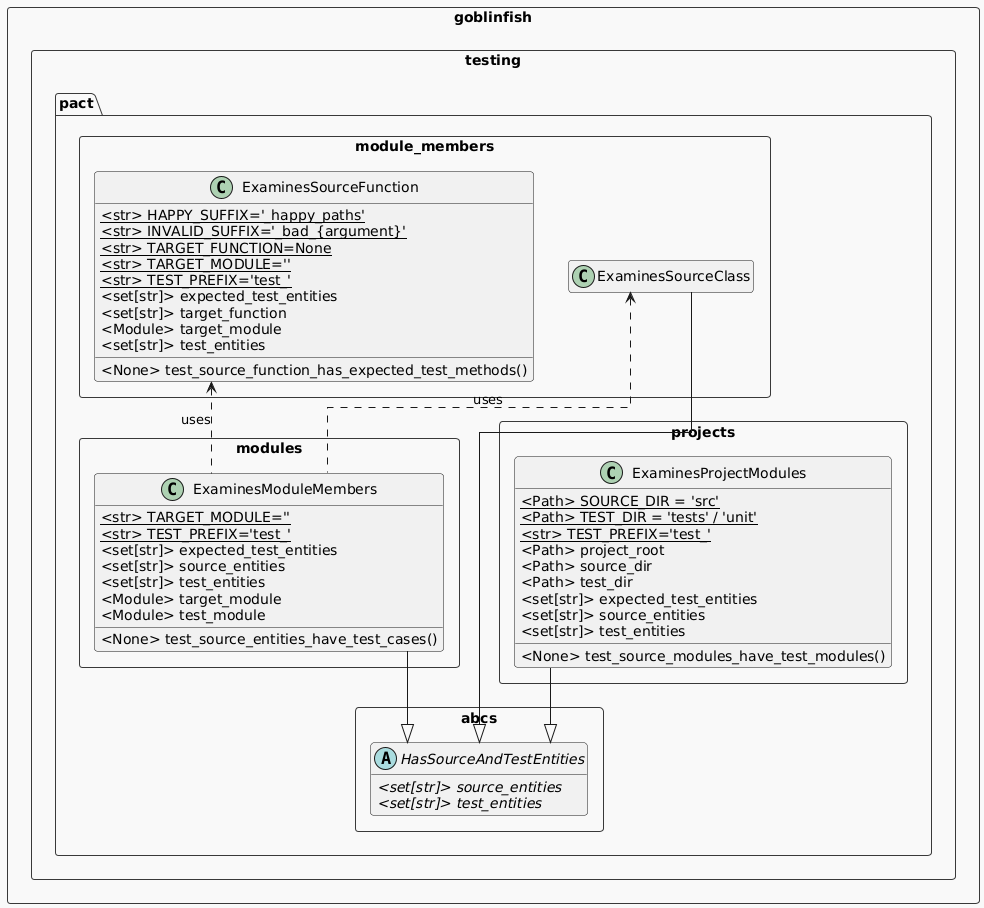
The main differentiator is not in what kinds of expectations are present, but in how those expectations are defined and applied to members of classes. With the exception of the main test-method (test_source_class_has_expected_test_methods), the implementation of the expected_test_entities and source_entiteis properties of the ExaminesSourceClass class, and the addition of an INVALID_DEL_SUFFIX used to identify test methods for invalid property and data-descriptor delete-methods, the relationships between the members of the ExaminesSourceClass class are pretty much identical to the members and relationships between them of the ExaminesSourceFunction class from the previous article. Diagrammed, those members’ relationships to each other are:

The key reason behind the differences between setting expectations between classes and functions is that classes have members, while functions do not. The members of classes that can be meaningfully tested to the extent that setting a testing expectation for them are limited to methods and data-descriptors. Methods, when it comes right down to it, are just functions that may have a common scope parameter: self for instance methods, indicating which object instance the method should act in relation to, or cls for methods that the @classmethod decorator has been applied to, indicating which class the method should act in relation to. There is also the @staticmethod decorator, which is used to attach a method to a class without either an instance or a class scope expectation. In all of these cases, the code for the method looks like a simple function, for example:

class MyClass:

    def instance_method(self):
        pass

    @classmethod
    def class_method(cls):
        pass

    @staticmethod
    def static_method():
        pass

The identification of any method in the target_class by the source_entities property uses the built-in inspect.getmembers function to find members, using the built-in callable function to detect callables, and inspect.isclass to filter out any callables that are classes rather than functions or methods. Similarly, the source_entities property uses inspect.getmembers in conjunction with the inspect module’s isdatadescriptor function to identify members defined as properties with the property decorator.

Warning

As I was writing this article, and doing the relevant review, I noticed a discrepancy between how source_entities behaves in comparison with expected_test_entities. I’m not sure if it is significant or not as I’m writing this, but since this article is being written about v.0.0.3 and the current repo version is v.0.0.6, it won’t really be addressed until v.0.0.7 if it is a problem.

Properties, and data descriptors in general, are objects attached to the classes they are members of, following an interface structure that is hinted at in the Pure Python Equivalents: Properties example of the Descriptor HowTo Guide. Descriptors have __get__, __set__ and __delete__ methods, and property objects augment that with fget, fset and fdel members that contain the getter-, setter-, and deleter-methods that are written in user-generated code like so:

class MyClass:

    @property
    def name(self):
        ...

    @name.setter
    def name(self, value):
        ...

    @name.deleter
    def name(self):
        ...

Because a data-descriptor may be a property or a custom descriptor type, and thus may or may not have the property-specific fget, fset and fdel members, the expectations for test-methods for properties and descriptors may not be able to reliably determine if the related actions need to be tested. That is, a property might be defined with a getter and setter, but no deleter, in which case its fdel member will be None. A non-property descriptor is expected to always have the __get__, __set__ and __delete__ member methods, but they might not be implemented, and there may not be a good way to make that distinction without simply requiring that all non-property descriptors test all three methods’ actions. The fact that all of those members and methods are, themselves, defined as methods still allows the same parameter/argument expectations to be determined: the example name property above could be expected to have test_name_happy_paths and test_set_name_bad_value test-methods, testing the happy-path set/get processes, and unhappy set-scenarios, respectively. It would also need a test_name_invalid_del test-method, assuming that the property has a deleter. If name were defined as a more generic data-descriptor.

Tip

There are other implementations that behave in ways similar to property and general descriptor objects that may not implement the descriptor interface. I know of one example offhand: the various Field types provided by Pydantic. Those will have to be handled with more specific functionality later, but that won’t be a consideration until the v.1.0.0 version of this package is complete.

With those properties added to the MyClass class, running the test-suite before adding any of the expected test-methods results in the expected failures:

================================================================
...
AssertionError: False is not true : 
  Missing expected test-method - test_class_method_happy_paths
================================================================
...
AssertionError: False is not true :
  Missing expected test-method - test_name_set_bad_value
================================================================
...
AssertionError: False is not true :
  Missing expected test-method - test_name_invalid_del
================================================================
...
AssertionError: False is not true :
  Missing expected test-method - test_instance_method_happy_paths
================================================================
...
AssertionError: False is not true :
  Missing expected test-method - test_static_method_happy_paths
================================================================
...
AssertionError: False is not true :
  Missing expected test-method - test_name_happy_paths
----------------------------------------------------------------

After adding all of the expected test-methods reported as missing, the example project’s structure looks like this:

project-name/
├─ Pipfile
├─ Pipfile.lock
├─ .env
├─ src/
│   └─ my_package/
│      └─ module.py
│         ├─ ::MyClass
│         │  ├─ ::instance_method() # instance method
│         │  ├─ ::name              # property
│         │  ├─ ::class_method()    # class method
│         │  └─ ::static_method()   # static method
│         └─ ::my_function()
└─ tests/
    └─ unit/
       └─ test_my_package/
          ├─ test_project_test_modules_exist.py
          │  └─ ::test_ProjectTestModulesExist
          └─ test_module.py
             ├─ ::test_MyClass
             │  │  # Property tests
             │  ├─ ::test_name_happy_paths
             │  ├─ ::test_name_invalid_del
             │  ├─ ::test_name_invalid_del
             │  │  # Method tests
             │  ├─ ::test_instance_method_happy_paths
             │  ├─ ::test_class_method_happy_paths
             │  └─ ::test_static_method_happy_paths
             └─ ::test_my_function

And, finally, the complete module_memberes class-diagram looks like this:

At this point, the package does everything that the most basic interpretation of my initial desires required: With adequate inclusion of the project- and module-level tests, and some short but relatively tedious manual effort to stub out the test-suite for the package itself, there are 108 test methods defined, 96 of which are still pending implementation. The results of the test-suite show that clearly:

===================== test session starts ======================
tests/unit/test_goblinfish/test_testing/test_pact/test_abcs.py 
                                              ..ssssssss  [  9%]
tests/unit/test_goblinfish/test_testing/test_pact/
    test_module_members.py 
           .ssss.sssssssssssssssssssss.ssssssssssssssss.  [ 50%]
tests/unit/test_goblinfish/test_testing/test_pact/
    test_modules.py              .ssss.sssssssssssssssss  [ 72%]
tests/unit/test_goblinfish/test_testing/test_pact/
    test_pact_logging.py                               .  [ 73%]
tests/unit/test_goblinfish/test_testing/test_pact/
    test_project_test_modules_exist.py                 .  [ 74%]
tests/unit/test_goblinfish/test_testing/test_pact/
    test_projects.py                ss.sssssssssssssssss  [100%]
================= 12 passed, 96 skipped in 0.05s ===============

Running a coverage report shows about what I’d expect at this point as well: a fair bit of the code is being called in most cases, but nowhere near what I’d like. The module_mambers.py missing-lines report is most of the source file, modules.py has 7 substantial chunks identified as currently untested, and projects.py has 4. Even just the simple percentages reported are a good indicator:

Name Stmts Miss Cover
src/goblinfish/testing/pact/abcs.py 13 3 77%
src/goblinfish/testing/pact/module_members.py 131 129 2%
src/goblinfish/testing/pact/modules.py 74 44 41%
src/goblinfish/testing/pact/pact_logging.py 18 5 72%
src/goblinfish/testing/pact/projects.py 63 15 76%

Still, as I noted in the first article in this series, I hadn’t originally planned to get tests actually implemented until after this point had been reached. After the little bits of chaos that interfered with that original plan, which I’ll get into more detail about in the next article, actual test-implementations and the fixes that would come of that were deferred until v.0.0.7, which I’ll get into in the article after next.

Monday, April 28, 2025

The PACT for functions

Note

This version of the package was tagged as v.0.0.3 in the project repository, and can be examined there if desired. This post will cover only part of the changes in that version, with the balance in the next post.

The next layer in from the module-members testing discussed in the previous article is focused on testing that the members identified there have all of the expected test-methods. As noted there, this testing-layer is concerned with callable members: functions and classes, specifically. Beyond the fact that they are both callable types, there are significant differences, which is why the wrappers for testing functions and classes were broken out into the two classes that were stubbed out earlier: the ExaminesSourceClass and ExaminesSourceFunction classes.

The fundamental difference that has to be accounted for that led to those two classes being defined is in how those member-types are called, and what happens when they are called. In the case of a function, the resulting output is completely arbitrary, at least from the standpoint of testing. A function accepts some collection of arguments, defined by its signature parameters, does whatever it’s going to do with those, and returns something, even if that return value is None.

A class, on the other hand, is always expected to return an instance of the class — an object — when it is called. That instance will have its own members, which are equally arbitrary, but can include both methods (which are essentially functions) and properties. It’s important to note that these properties have code behind them that make them work — they are a specific type of built-in data descriptor type, with methods that are automatically recognized and called by the Python interpreter when a get, set, or delete operation is called against the property or descriptor of a given object.

Class attributes, without any backing logic or code, fall into the same sort of testing category that module attributes do, also noted in a previous article. Specifically, while it’s absolutely functionally possible to test a class attribute, that attribute is, by definition, mutable: There is nothing preventing user code from altering or even deleting a class attribute, or that attribute as it is accessed through a class instance. Since the primary focus of the PACT testing idea is testing the contracts of test-targets, and attributes are as mutable as they are, they really cannot be considered as “contract” elements of a class.

After thinking all of those factors through, I decided that my next step, the first new code that would be added to this version of the package, would be focused on testing functions. The main thought behind that decision is that establishing both the rule-sets and implementation patterns for function-test requirements would provide most of the rules and implementation patterns for class-members as well: Methods of classes are just functions with an expected scope argument (self or cls), and properties and other data descriptor implementations are just classes with a known set of methods. On top of that, functions implicitly have contracts, represented by their input parameters and output expectations, so accounting for those in defining the test-expectations for functions would carry over to methods and properties later.

The test-expectations that I landed on after thinking through all of that boiled down to:

Goal
  1. Every function should have a corresponding happy-paths test method, testing all permutations of a rational set of arguments across the parameters of the function.
  2. Every function should also have a corresponding unhappy-path test-method for each parameter.

The goals for each of these test-expectations are still similar to the goals for test-expectations in previous versions’ tests: To assert that a given, expected test-entities exist for each source-entity. Because functions have their own child entities — the parameters that they expect — those expectations need to account for those parameter variations in some manner. My choice of these two was based on a couple of basic ideas: The happy-path test for a given function is, ultimately, intended to prove that the function is behaving as expected when it is called in an expected fashion. I fully expect that happy-path tests might be fairly long, testing a complete, rational subset of “good” parameter values across all of the logical permutations that a given function will accept. I do not expect that happy-path tests would need to be (or benefit from being) broken out into separate tests for each general permutation-type, though.

The unhappy-path tests, to my thinking, should build on the happy-path test processes as much as possible. Specifically, I’m intending that each unhappy-path test will use a happy-path argument-set as a starting-point for its input to the target function, but replace one of the arguments with a “bad” value for each rational type or value that can be considered “bad.”

An example seems apropos here, since I haven’t been able to come up with a more concise way to describe my intentions without resorting to code. Consider the following function:

def send_email(address: str, message: str, *attachments: dict):
    """
    Sends an email message.

    Parameters:
    -----------
    address : str
        The address to send the message to
    message : str
        The message to send. May be empty.
	attachments : dict
        A collection of attachment specs, providing a
        header-name (typically "Content-Disposition")
        and value ("attachment"), a filename (str, or
        tuple with encoding specifications), and a
        file pointer to the actual file to be attached.
	"""
	# How this function actually works is not relevant
    # at this point
	...

The happy-path test-method for this function, test_send_email_happy_paths, would be expected to call the send_email function with both a general email address and a “mailbox” variant (john.smith@test.com and John Smith <john.smith@test.com>), with both an empty message, and a non-empty one, and with zero, one, and two attachments arguments. That’s a dozen variations, but they should be relatively easy to iterate through, even if they have to be split out in the test-code, whether for readability, or to check that some helper function was called because of circumstances for a given call to the target function (for example, an attachment-handler sub-process).

The unhappy-path tests, and what they use for their arguments break out in more detail based on which “unhappy” scenario they are intended to test:

  • test_send_email_bad_address would be expected to test for invalid email address values, and possibly for non-string types if there was type-checking involved in the processing for them, but could use the same message and attachments values for each of those checks.
  • test_send_email_bad_message could use the same address and attachments values, since it would be concerned with testing the value and/or type of some invalid message arguments.
  • test_send_email_bad_attachments could use any valid address and message values, as it would be testing for invalid attachments elements.

As with the test-expectations established in previous versions, the test-process for functions is only concerned with asserting that all of the expected test-methods exist. That is a hard requirement that’s implemented by application of the pact testing mix-ins. The intention behind that is to promote implementation of test-methods when possible/necessary, or to promote them being actively skipped, with documentation as to the reason why it is being skipped. That’s worth calling out, I think:

Warning

The pact processes do not prevent a developer from creating an expected test-method that simply passes. That risk should be mitigated by application of some basic testing discipline, or by establishing a standard for tests that are not implemented!

Using the send_email function as an example, and actively skipping tests for various reasons with the unittest.skip decorator, the test-case class might initially look something like this, after implementing the happy-paths tests that were deemed more important:

class test_send_email(unittest.TestCase, ExaminesSourceFunction):
    """Tests the send_email function"""

    def test_send_email_happy_paths(self):
        """Testing send_email happy paths"""
        # Actual test-code omitted here for brevity

    @unittest.skip('Not implemented, not a priority yet')
    def test_send_email_bad_address(self):
        """Testing send_email with bad address values"""
        self.fail(
            'test_send_email.test_send_email_bad_address '
            'was initially skipped, but needs to be '
            'implemented now.'
        )

    @unittest.skip('Not implemented, not a priority yet')
    def test_send_email_bad_message(self):
        """Testing send_email with bad message values"""
        self.fail(
            'test_send_email.test_send_email_bad_message '
            'was initially skipped, but needs to be '
            'implemented now.'
        )

    @unittest.skip('Not implemented, not a priority yet')
    def test_send_email_bad_attachments(self):
        """Testing send_email with bad attachments values"""
        self.fail(
            'test_send_email.test_send_email_bad_attachments'
            'was initially skipped, but needs to be '
            'implemented now.'
        )

This approach keeps the expected tests defined, but they will be skipped, and if that skip decorator is removed, they will immediately start to fail. Since the skip decorator requires a reason to be provided, and that reason will appear in test outputs, there is an active record in the test-code itself of why those tests have been skipped, and they will appear in the test logs/output every time the test-suite is run.

That covers what the goal is, in some detail. The implementation, how it works is similar, in many respects, to other test-case mix-ins already in the package from previous versions. For function testing, the new code was all put in place in the ExaminesSourceFunction class that was stubbed out in v.0.0.2. With the implementation worked out, that class’ members can be diagrammed like this:

As with previous mix-ins, the entire process starts with the test-method that the mix-in provides, test_source_function_has_expected_test_methods, and the process breaks out as:

  • test_source_function_has_expected_test_methods compares its collection of expected_test_entities against the actual test_entities collection, causing a test failure if any expected test-methods in the first do not exist in the second.
  • The expected_test_entities collection is built using the target_function to retrieve the name of the function and its parameters, along with the TEST_PREFIX, HAPPY_SUFFIX and INVALID_SUFFIX class attributes, which provide the test_ prefix for each method, the happy-path suffix for that test-method, and invalid-parameter suffixes for each parameter in the target_function parameter-set.
  • The target_function is retrieved using the name specified in the TARGET_FUNCTION class attribute, finding that function in the target_module, which is imported using the namespace identified in the TARGET_MODULE class-attribute.
  • The test_entities method-name set is simply retrieved from the class, using the TEST_PREFIX to assist in filtering those members.

Many of the defaults for the various class attributes have already been discussed in previous posts about earlier versions of the package. The new ones, specific to the ExaminesSourceFunction class are shown in the class diagram for the package at this point:

  • The HAPPY_SUFFIX, used to indicate a happy-paths test-method, defaults to '_happy_paths';
  • The INVALID_SUFFIX, is used to append a '_bad_{argument}' value to unhappy-path test-methods, where the {argument} is replaced with the name of the parameter for that test-method. For example, the address, message, and attachments parameters/arguments noted earlier in the example for the send_email function.
  • The TARGET_FUNCTION provides the name of the function being tested, which is used to retrieve it from the target_module, which behaves in the same fashion as the property by the same name in the ExaminesModuleMembers mix-in from v.0.0.2.

When v.0.0.2 was complete, the example project and its tests ended up like this:

project-name/
├─ Pipfile
├─ Pipfile.lock
├─ .env
├─ src/
│   └─ my_package/
│      └─ module.py
│         ├─ ::MyClass
│         └─ ::my_function()
└─ tests/
    └─ unit/
       └─ test_my_package/
          ├─ test_project_test_modules_exist.py
          │  └─ ::test_ProjectTestModulesExist
          └─ test_module.py
             ├─ ::test_MyClass
             └─ ::test_my_function

With a bare-bones my_function implementation like this:

def my_function():
    pass

…running the test_my_function test-case class, or the entire test-suite, immediately starts reporting a missing test-method:

================================================================
FAIL: test_source_function_has_expected_test_methods
...
[Verifying that test_my_function.test_my_function_happy_paths
exists as a test-method]
----------------------------------------------------------------
...
AssertionError: False is not true :
    Missing expected test-method - test_my_function_happy_paths
----------------------------------------------------------------

Adding the required test-method, being sure to use the skip-and-fail pattern shown earlier, like this:

class test_my_function(unittest.TestCase, ExaminesSourceFunction):
    TARGET_MODULE='my_package.module'
    TARGET_FUNCTION='my_function'

    @unittest.skip('Not yet implemented')
    def test_my_function_happy_paths(self):
        self.fail(
            'test_my_function.test_my_function_happy_paths '
            'was initially skipped, but needs to be implemented now.'
        )

…allows the test-case to run successfully, skipping that test-method in the process, and reporting the reason for the skip, provided that the test-run is sufficiently verbose:

test_my_function_happy_paths
    (test_my_function.test_my_function_happy_paths)
    skipped 'Not yet implemented'

If the function is altered, adding a positional argument, an argument-list, a keyword-only argument, and a typical keyword-arguments parameter, like so:

def my_function(arg, *args, kwonlyarg, **kwargs):
    pass

…then the test-expectations pick up the new parameters, and raise new test failures, one for each:

================================================================
FAIL: test_source_function_has_expected_test_methods 
...
[Verifying that test_my_function.test_my_function_bad_args
exists as a test-method]
...
----------------------------------------------------------------
...
AssertionError: False is not true :
    Missing expected test-method - test_my_function_bad_args
...
================================================================
...
[Verifying that test_my_function.test_my_function_bad_kwonlyarg
exists as a test-method]
...
----------------------------------------------------------------
...
AssertionError: False is not true :
    Missing expected test-method - test_my_function_bad_kwonlyarg
...
================================================================
...
[Verifying that test_my_function.test_my_function_bad_kwargs
exists as a test-method]
...
----------------------------------------------------------------
...
AssertionError: False is not true :
    Missing expected test-method - test_my_function_bad_kwargs
...
================================================================
...
[Verifying that test_my_function.test_my_function_bad_arg
exists as a test-method]
...
----------------------------------------------------------------
...
AssertionError: False is not true :
    Missing expected test-method - test_my_function_bad_arg
...
----------------------------------------------------------------

Adding those expected test-methods, unsurprisingly, allows the tests to pass, reporting on the skipped test-methods in the same manner as shown earlier:

class test_my_function(unittest.TestCase, ExaminesSourceFunction):
    TARGET_MODULE='my_package.module'
    TARGET_FUNCTION='my_function'

    @unittest.skip('Not yet implemented')
    def test_my_function_bad_arg(self):
        self.fail(
            'test_my_function.test_my_function_bad_arg '
            'was initially skipped, but needs to be '
            'implemented now.'
        )

    @unittest.skip('Not yet implemented')
    def test_my_function_bad_args(self):
        self.fail(
            'test_my_function.test_my_function_bad_args '
            'was initially skipped, but needs to be '
            'implemented now.'
        )

    @unittest.skip('Not yet implemented')
    def test_my_function_bad_kwargs(self):
        self.fail(
            'test_my_function.test_my_function_bad_kwargs '
            'was initially skipped, but needs to be '
            'implemented now.'
        )

    @unittest.skip('Not yet implemented')
    def test_my_function_bad_kwonlyarg(self):
        self.fail(
            'test_my_function.test_my_function_bad_kwonlyarg '
            'was initially skipped, but needs to be '
            'implemented now.'
        )

    @unittest.skip('Not yet implemented')
    def test_my_function_happy_paths(self):
        self.fail(
            'test_my_function.test_my_function_happy_paths '
            'was initially skipped, but needs to be '
            'implemented now.'
        )
When run, the test-case for the function reports the skipped methods, and their reasons, as expected:
test_my_function_bad_arg
    (test_my_function.test_my_function_bad_arg)
    skipped 'Not yet implemented'

test_my_function_bad_args
    (test_my_function.test_my_function_bad_args)
    skipped 'Not yet implemented'

test_my_function_bad_kwargs
    (test_my_function.test_my_function_bad_kwargs)
    skipped 'Not yet implemented'

test_my_function_bad_kwonlyarg
    (test_my_function.test_my_function_bad_kwonlyarg)
    skipped 'Not yet implemented'

test_my_function_happy_paths
    (test_my_function.test_my_function_happy_paths)
    skipped 'Not yet implemented'
After these additions, this example project looks like this:
project-name/
├─ Pipfile
├─ Pipfile.lock
├─ .env
├─ src/
│   └─ my_package/
│      └─ module.py
│         ├─ ::MyClass
│         └─ ::my_function(arg, *args, kwonlyarg, **kwargs)
└─ tests/
    └─ unit/
       └─ test_my_package/
          ├─ test_project_test_modules_exist.py
          │  └─ ::test_ProjectTestModulesExist
          └─ test_module.py
             ├─ ::test_MyClass
             └─ ::test_my_function
                ├─ ::test_my_function_bad_arg
                ├─ ::test_my_function_bad_args
                ├─ ::test_my_function_bad_kwargs
                ├─ ::test_my_function_bad_kwonlyarg
                └─ ::test_my_function_happy_paths

While the equivalent test-processes for class-members still needs to be implemented, there are already significant gains at this point in prescribing tests for functions. The fact that all of the types of class-members that an active contract testing process really needs to care about are, themselves, just variations of functions means that the processes implemented for function-testing will at least provide a baseline for implementing class-member test expectations. They may even use the exact same code and processes. That said, this post is long enough already, so the implementation and discussion of the class-member pact processes will wait until the next post.

Friday, April 25, 2025

The PACT for module-members

Tip

This version of the package was tagged as v.0.0.2 in the project repository, and can be examined there if desired. There are some issues with this version that I discovered while writing this article that will be corrected in the package version that was in progress at the time, but functionally the 0.0.2 version does what it was intended to do.

The next layer in of the PACT approach is concerned with prescribing required test-case classes for each member of a given source module. Given the goal that I mentioned in the first article in the series:

Goal

Every code-element in a project’s source tree should have a corresponding test-suite element.

…and this version’s focus on module members, it’s probably worth talking about what kinds of members this version is going to focus on. From a purely technical standpoint, there’s nothing that functionally prevents value-only members — attributes — from having tests written against them, but that is not my primary focus. What I’m concerned with, at least for now, are members that have actual code behind them, that do things, or represent things in the structure of the source code. In short, I’m concerned with testing functions and classes. With that in mind, the specific variation of the “every code-element” rule above for the purposes of this version of the package could be summarized as:

Goal

Every source function and class should have a corresponding test-case class.

For example, given a my_module.py with a my_function function, and a MyClass class, the goal here is to assert that the related test_my_module.py in the test-suite has test-case classes for each: test_my_function and test_MyClass. Following the same pattern mentioned in the previous article, the success or failure of the test provided by the mix-in class is simply no failed assertions that the expected test-case classes exist in the test-module that the test itself lives in.

At a high level, there are several similarities between this test-process and the previous version’s test: There is a class (ExaminesModuleMembers) that defines a single test-method (test_source_entities_have_test_cases) that actually executes the test in question, and there are several supporting properties that the mix-in class provides to facilitate that process. The relationships between those elements can be diagrammed as:

The overall process executed by the test_source_entities_have_test_cases test-method breaks down as follows:

  • The test-method iterates over a collection of expected_test_entities names, asserting that each expected member exists, that each existing member is derived from unittest.TestCase, and that each existing member is also derived from another class that the PACT package provides (more on that later). Each of these iterations’ assertions happen inside a subTest context, allowing each individual potential failure to be captured and reported on independently from any others.
  • The expected_test_entities property uses the source_entities property to define the base names for the expected classes, prepending each name with the TEST_PREFIX string to generate the final expected name for each member in the collection.
  • It also uses the test_entities property in its iteration, which simply collects all of the member-names in the test_module.
  • The source_entities property collects the names of all of the callable members of the target_module.
  • The target_module simply returns the module designated by the namespace provided in the TARGET_MODULE class-attribute. This process uses functionality from the built-in importlib package to perform an actual import of the target module.
  • Similarly, the test_module is just a reference to the actual test-module that the test is defined in.

The importlib functionality that is used is wrapped so that it can check to see whether the specified namespace import is already present: If it is, whether as a general import at the module level, or as a result of some other test-class executing a similar import, it avoids re-executing the import process, but still stores the imported result for access elsewhere.

Finding the various members of both the target_module and test_module is handled by functionality provided by the built-in inspect module. The basic acquisition of module-members is a simple call to the getmembers function it provides, and the class-vs.-function determination is handled by checking whether a given member of the relevant module is a class with the isclass function. In all of those contexts, if a given element (by name) is not a class, it has already been determined to be a callable, and is assumed to be a function instead.

The differentiation between classes and functions, for testing purposes, is eventually going to be handled by a pair of other classes, not yet defined in detail, that will encapsulate the test-process requirements for each. There are some differences between those source elements that make this distinction necessary, even if it’s only stubbed out at this point in the package’s code:

  • A function’s tests will, ultimately, be concerned with requiring a “happy-paths” test-method for the function, which is expected to test all the rational subsets of “good” arguments.
  • Tests for functions that have arguments will also be expected to provide “unhappy-path” tests for each individual parameter. That is, given a function with arg, *args, kwdonlyarg, and **kwargs parameters, the test-case for that function will be expected to have an unhappy-path test for arg, args, kwdonlyarg, and kwargs, testing for a reasonable subset of invalid argument-values for those parameters.
  • Tests for classes, on the other hand, will need to account for test-cases for the methods of that class — which will follow the same basic rules as function-tests — as well as for properties and other data-descriptors.

Those points of differentiation do not need any real functionality behind them at this stage in development, but they do need to be accounted for. Following the naming convention that’s been established up to this point, those classes will be named ExaminesSourceClass and ExaminesSourceFunction, and they will live in an otherwise empty (for now) module_members.py module.

Taking all of those into account, the package structure in v.0.0.2 looks like this:

With just the changes made in this version, a pattern for manually implementing a full PACT test-suite is starting to emerge. With the previous version, all that needed to be done was to create the initial test-module, populate it with a bare-bones PACT-based test-case class, then run the test-suite, correct any failures reported, and repeat until there were no more failures. The same basic pattern can be applied at the module-members level, though it could get very tedious for larger code-bases that don’t have tests in place. Before that process starts, the the example described earlier, with the my_function function and MyClass class living in my_package/my_module.py, and the test_my_package/test_module.py test-module required looks something like this:

project-name/
├─ Pipfile
├─ Pipfile.lock
├─ .env
├─ src/
│   └─ my_package/
│      └─ module.py
│         ├─ ::MyClass
│         └─ ::my_function()
└─ tests/
    └─ unit/
        └─ test_my_package/
           ├─ test_project_test_modules_exist.py
           │  └─ ::test_ProjectTestModulesExist
           └─ test_module.py

Setting up the first test-case class, deriving from unittest.TestCase and the newly-minted ExaminesModuleMembers, like this:

class test_ProjectTestMembersExist(
    unittest.TestCase,
    ExaminesModuleMembers
):
    TARGET_MODULE='my_package.module'

…then running the revised test-module, either directly from the IDE, or by re-running the suite from the command-line with…

# Assuming pipenv is in play, omit "pipenv run" if not...
pipenv run python -m unittest discover -s tests/unit/test_my_package

…yields two failures, one for each of the missing-but-expected test-case classes that need to be defined. The relevant lines of the test-failure outputs are:

=================================================================
...
AssertionError: False is not true :
    No test-case class named test_Class is defined in
    test_module.py
=================================================================
...
AssertionError: False is not true :
    No test-case class named test_Function is defined in
    test_module.py
Tip

The test-suite could just as easily be run with pytest, but, while it will run all of the subTest-context tests, it will only report on the first failure in one of those contexts: The test_Function failure, in this case.

Adding a bare-bones test-case class for any single failure reported, like this example handling the missing test_Function test-case:

class test_Function(unittest.TestCase, ExaminesSourceFunction):
    pass

…will resolve that failure, leaving only:

=================================================================
...
AssertionError: False is not true :
    No test-case class named test_Class is defined in
    test_module.py

The test-process, as noted earlier, will also assert that an expected test-case class is derived from both unittest.TestCase and one of the ExaminesSource* classes. So, for example, starting with class that has neither of those requirements:

class test_Class:
    pass

…will raise a test failure looking like this when the test is run:

=================================================================
AssertionError: False is not true :
    The test_Class class is exepcted to be a subclass of
    unittest.TestCase, but is not:
    (<class 'test_module.test_Class'>, <class 'object'>)

Adding the missing requirement:

class test_Class(unittest.TestCase):
    pass

…and re-running the test will raise a different failure, intended to require that the relevant ExaminesSource* class will also be in place:

=================================================================
AssertionError: False is not true :
    The test_Class class is exepcted to be a subclass of
    ExaminesSourceClass, 
    but is not: (<class 'test_module.test_Class'>,
    <class 'unittest.case.TestCase'>, <class 'object'>)

Once all of the required parent classes are in place, though, these tests will pass.

Tip

Obviously, knowing that any given test-case class will need to be defined with both of the relevant parent classes will speed things along substantially. In cases where that is not known ahead of time — perhaps in conjunction with an AI agent like Claude Code, for example — the intent was to provide enough information that a developer completely unfamiliar with the PACT requirements, or an assistant system that needs that information, can iterate against failures until they are all resolved.

By the time all of the required test-cases are in place in the example project, it looks like this:

project-name/
├─ Pipfile
├─ Pipfile.lock
├─ .env
├─ src/
│   └─ my_package/
│      └─ module.py
│         ├─ ::MyClass
│         └─ ::my_function()
└─ tests/
    └─ unit/
       └─ test_my_package/
          ├─ test_project_test_modules_exist.py
          │  └─ ::test_ProjectTestModulesExist
          └─ test_module.py
             ├─ ::test_MyClass
             └─ ::test_my_function

So, at this point, the PACT test-processes can identify and require missing test-modules (from the previous version), and missing test-case classes for source-module members that those test-modules relate to. The process for implementing the complete set of required tests is growing in complexity, and may be painful (but at least be tedious) for large bodies of source-changes that need to be accounted for. The tests put in place still make no assumptions about whether they should be executed: it would be quite possible to apply any of the various unittest.skip* decorators decorators, or perhaps the expectedFailure decorator for certain types of test contexts, without changing the pass/fail of the test itself. At this level, skipping the PACT tests would involve skipping all of the tests in the relevant test-case class, though — that seems an unlikely need, but it’s worth bearing in mind should the need arise.

The configuration involved in the ExaminesModuleMembers class has only briefly been touched on with the mention of the TARGET_MODULE and TEST_PREFIX class-attributes noted earlier. The TARGET_MODULE attribute must be defined in order for the import-process that provides target_module, and the source_entities that are retrieved from that module. The TEST_PREFIX, like its counterpart in the ExaminesProjectModules class previously defined and discussed in the previous article, defines the prefix for the names of the test-case classes. It has the same default value: test_.

This layer, captured in the 0.0.2 version of the package, handles the detection of expected test-case classes, as well as asserting that they are of an appropriate type, for each member of a source module that testing is concerned with. The next layer in, which will be covered in the 0.0.3 version and related article here, will concern itself with requiring test-methods in the ExaminesSourceClass and ExaminesSourceFunction classes that were stubbed out here.

Local AWS API Gateway development with Python: The initial FastAPI implementation

Based on some LinkedIn conversations prompted by my post there about the previous post on this topic , I feel like I shoul...